
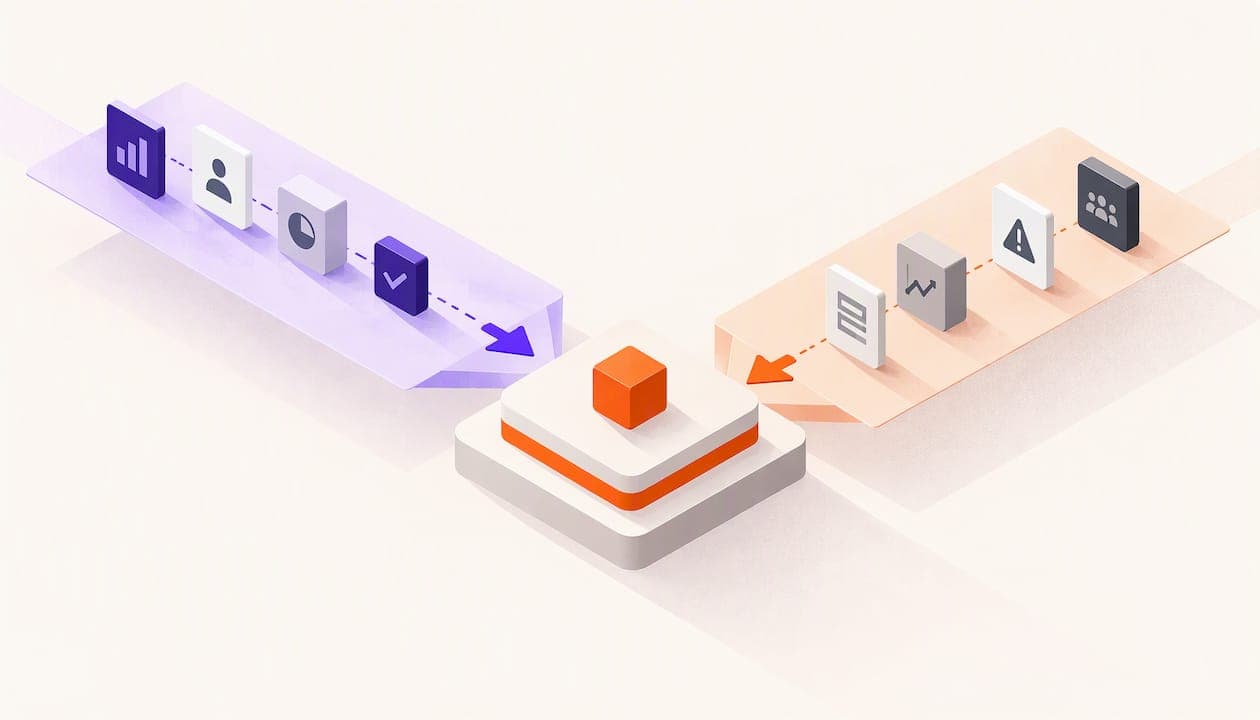
Renewal risk signals are the changes in customer behavior that show an account may not renew: falling usage, a champion who left, slower replies, frustrated support tickets, billing trouble, or documents nobody opens anymore. The useful ones show up months before the renewal date, while you can still do something about them. This guide covers the signals worth tracking, how to tell a real warning from a blip, and how to turn them into a simple score your team will actually use.
TL;DR
- The best renewal risk signals are behavioral and trend-based: usage, stakeholder changes, response speed, support tone, and billing events.
- One flag is a reason to look closer. Two flags at the same time are a reason to review the account.
- Watch trends over several weeks, not single bad days, and set thresholds from your own history.
- Shared content, such as renewal proposals, QBR decks, and ROI summaries, gives you an engagement signal that sits outside your product data.
- Attach a required action to every risk level so a signal turns into a call, not a dashboard color.
Table of Contents
- Why you need signals before the renewal conversation
- Product usage signals
- Stakeholder and communication signals
- Support, sentiment, and billing signals
- Engagement with shared content: the signal most teams skip
- How to tell a real signal from a blip
- Combine signals into one score
- What we believe about renewal signals
- Validate before you act
- Track document signals with WarmDoc
- FAQ
- Sources
Why you need signals before the renewal conversation
By the time a customer says "we're looking at other options," the decision is often half made. Churn prediction work starts from the same idea: use customer data to estimate who may cancel or not renew, because warning signs can appear months before renewal, while there is still time to act.
There is also a trap. Some renewal signals are available for months while usage can still look fine. A healthy login count does not tell you the buyer left, the budget moved, or the team quietly stopped caring about the outcome you sold.
TSIA's research points the same way on adoption. It wrote in 2025 that attrition often relates to poor adoption or weak engagement, and it recommended measuring adoption and engagement throughout the year so teams can step in before contracts are up. Its benchmark data also linked monthly or quarterly value-oriented contact with churn rates 6 points lower than having no consistent contact strategy. Regular contact is not just relationship upkeep. It shows up in the numbers.
If you want a deeper look at the contact side, this overview of customer retention strategies covers how consistent communication and clear product value keep software customers around.
Product usage signals
Usage is the first place most teams look, and for good reason. These are the patterns that matter most.
- Declining login frequency, especially among the people who used to log in daily.
- Features that were active and now sit unused.
- Fewer teammates using the product than at launch.
- A drop in the champion's email open rate.
- Usage below the minimum your plan assumes.
That list follows TrailSpark's renewal documentation, which treats declining or absent activity as a key retention signal.
TSIA describes low adoption in plain terms: very few logins, limited feature use, or trouble working the product into daily workflows. It calls low adoption a significant churn risk.
Early lifecycle matters too. One renewal-risk guide argues that missing an activation milestone in the first 30 to 60 days can predict trouble at a renewal 10 to 12 months away. Treat that as a hypothesis to test against your own accounts, but it is a good reason to review onboarding data, not just the last 30 days.
Multi-user drop-off
A single power user can hide a dying account. If five people used the product in month two and one uses it in month ten, the renewal now depends on one person's calendar and goodwill. Count active users per account over time, not only total activity.
Stakeholder and communication signals
People change faster than software. These signals are about who is in the room and how they respond.
Champion or sponsor turnover
A champion leaving is one of the most common causes of renewal trouble. The original buyer often takes the motivation for the purchase with them, which is why stakeholder turnover is treated as a critical early warning. A quick check: is the original buyer still active, do new names appear in threads, and has anyone senior engaged in the last quarter?

Slower replies and thinner conversations
Slower feedback, lower attendance, and less detailed discussion all create a visibility problem between QBRs. Silence may mean disengagement. It may also mean the customer is busy, tired of repetitive requests, or tired of surveys. So treat quiet as a prompt to reach out with something useful, not as a verdict.
One customer-success practitioner makes the broader point that silence is not safety: no replies, no usage, no executive involvement, and zero support activity can all look like a calm account when they are really a checked-out one.
Support, sentiment, and billing signals
These tend to be louder, but they are easy to misread.
- Support tone over ticket count. A previously engaged customer who turns terse or frustrated is a negative sign, and sentiment in tickets matters more than volume.
- Repeated unmet requests. An account that has asked for the same capability in three consecutive quarters has a documented reason to evaluate alternatives.
- Reliability complaints or data-export requests.
- Payment failures, downgrade requests, and unusual billing questions.
Surveys lag. One analysis notes that by the time a customer rates you a detractor, the relationship damage is often 60 to 90 days old. Use survey scores as confirmation, not as your alarm.
Engagement with shared content: the signal most teams skip
Product data tells you what people do inside your tool. It says little about what they do with the documents that drive the decision: the renewal proposal, the QBR deck, the ROI summary, the pricing sheet.

That is where document engagement helps. When you send a renewal proposal, you can see whether it was opened, which pages were read, how long the reader spent on pricing, and whether it was forwarded to someone new. A forward can mean the decision is moving up to finance or an executive you have not met. A proposal that sits unopened for a week can mean the same thing as a missed email: no one owns the decision.
What it can reliably indicate:
- Whether the people you think matter are reading anything at all.
- Which topics get attention (pricing, security, implementation, results) and which get skipped.
- Whether new stakeholders have entered the conversation through a forwarded link.
- Whether attention is rising or falling across your last several documents.
What it cannot do alone: explain why. A skipped results page might mean the customer already believes in the results, or that they stopped caring. Pair it with a call. And be careful with raw opens, since email security scanners can trigger them. Page-level attention and forwarding are much harder to fake than a single open.
We built WarmDoc's page-level analytics for this kind of read. If you want the sales-side version of the same idea, our guide to turning document engagement into buyer intent signals walks through it, and the sales content audit shows how to trigger a same-day follow-up from what you see.
How to tell a real signal from a blip
Vacations, company holidays, and quarter-end crunches all depress usage and slow replies. You do not want to panic over a quiet week in late December.
- Look at consecutive weeks. A sustained, multi-week decline matters more than a daily drop, and a divergence where usage falls while ticket volume spikes points to real friction.
- Track the slope. Sentiment direction over the contract term matters more than its level on any one day.
- Calibrate to your own history. CMSWire's recent coverage calls thresholds operating hypotheses that need calibrating to your organization, and gives examples such as a 20% drop in active usage, any champion change, and late or failed payments. Use those as starting points, not rules.
- Count flags. The same piece cautions that one flag is not conclusive, and that two at once should trigger an account-risk review.
A quick example. A customer's weekly active users fall 25% over four weeks. Alone, that could be a seasonal lull. Now add that their sponsor's name vanished from the last two email threads and the renewal proposal you sent was opened once, on one page, and never forwarded. That is three signals pointing the same direction, and it is time for a call this week.
Combine signals into one score
Single indicators mislead. The guidance is consistent: combine product usage, support, and engagement signals into a composite risk view, rank declining accounts by contract value, and use the result to guide customer conversations. RevOps guidance goes further and recommends mixing CRM ownership and renewal data with product engagement, support, feedback, billing, and contract information rather than trusting a single health indicator.
Here is a simple starting model.
| Signal group | Example indicator | What a warning looks like |
|---|---|---|
| Usage | Weekly active users | Multi-week decline, fewer teammates |
| Stakeholders | Champion and executive contact | Champion gone, no senior contact this quarter |
| Communication | Reply time, meeting attendance | Slower replies, fewer attendees |
| Support | Ticket tone and repeat requests | Frustration, same ask for three quarters |
| Billing | Payment and plan changes | Failed payment, downgrade request |
| Shared content | Page views and forwards | Proposal unread, pricing page skipped, no forwarding |
Give each group a measurable rule, then assign green, yellow, or red. For building the score itself, this walkthrough on CRM hygiene and customer health scores shows how to keep the underlying data clean enough to trust.
Attach an action to every color
A score with no next step is decoration. Decide in advance:
- Green: normal cadence, share a results recap each quarter.
- Yellow: the account owner reaches out within a week with something useful, such as a usage review or a new use case.
- Red: manager review, sponsor outreach, and a save plan before the renewal window opens.
One caution. Indicators vary by industry, product, and customer segment, so what is red for a 10-seat team may be normal for an enterprise account. Build your thresholds per segment and revisit them after each renewal cycle.
What we believe about renewal signals
We see renewal risk as an attention problem. Customers rarely announce they are leaving. They stop paying attention, and attention leaves traces.
The strongest traces are the ones that cost the customer a little effort: opening a proposal, reading the pricing page, forwarding it to a colleague. Those actions are harder to produce by accident than a login or an email open, which is why we built WarmDoc around page-level views and forwarding detection instead of simple opens. When a deck gets forwarded to someone senior, that is real interest. When a renewal proposal stays cold, that is real information too.
We also think signals should help you act like a person, not a machine. Use them to decide who to call and what to talk about. Then send the tracked link from your own inbox, so the message still sounds like you.
— Ty
Validate before you act
A signal is a question, not an answer. Before you escalate, check it with the customer in a way that does not feel like an audit.
- Ask a value question. "What outcome matters most this quarter?" often reveals shifts in priorities.
- Share something useful. A short results recap gives the customer a reason to reply and shows you what they read.
- Find a second voice. If your champion is quiet, ask for an introduction to a teammate or their manager.
- Offer a fix. If the signal is low adoption, propose a short enablement session instead of waiting.
- Log what you learn. Note whether the signal was right, so your thresholds improve.
Timeline matters. Start this at least a quarter before renewal, not a week before. Our follow-up cadence guide shows how to space touches so each one carries new information.
Track document signals with WarmDoc
If your renewals depend on proposals, QBR decks, and ROI summaries, WarmDoc shows you which pages each recipient read, whether a deck was forwarded, and which accounts are running hot, warm, or cold. You get real-time notifications, team analytics, and a Zapier integration to push signals into your other tools.
The Free plan costs $0 per month. Pro is $19 per month per user, and Team is $39 per month per user, with annual billing at $190 and $390 per user per year. Start free or see pricing.
FAQ
What are the most common renewal risk signals?
The most common are declining product usage, a champion or sponsor leaving, slower customer responses, frustrated support tickets, payment problems, and repeated feature requests that go unmet. Trends matter more than any single event. Two or more at once deserve an account review.
How early can you spot renewal risk?
Often months ahead. Warning signs can appear well before the renewal conversation, and early onboarding gaps may foreshadow trouble nearly a year out. Review accounts on a regular cadence, not only when the renewal date approaches.
Is a drop in usage always a sign of churn?
No. Holidays, vacations, and busy seasons all lower usage. Look for a decline that lasts several weeks, and check whether other signals, such as stakeholder changes or slower replies, show up alongside it.
Can document tracking help with renewals?
Yes, as one signal among several. Page-level views and forwarding on renewal proposals and QBR decks show who is paying attention and whether new decision makers have joined. Use it to decide who to contact, then confirm what you see in a conversation.
Sources
- Churn Prediction: How to Build a Model and Forecast Renewals
- The Impact of a Customer Contact Strategy on Churn Rates
- Top Customer Growth and Renewal Questions Answered
- 3 Levels of Customer Adoption Explained
- The 7 Renewal Risk Signals to Review Before Every Renewal
- Renewal / Retention Motion, TrailSpark Docs
- SaaS Renewal Risk Signal Map
- What to do when customer feedback goes quiet between QBRs
- The Silent Signals of Customer Risk You're Probably Missing
- Churn prediction for SaaS: how to spot at-risk accounts
- How to Identify At-Risk Customers Before Renewal
- Is Your Customer Experience Still Waiting for Symptoms?
- Why Your Health Score Is Missing the Renewals That Actually Churn
- 10 Renewal Risk Indicators RevOps Must Watch in 2026