
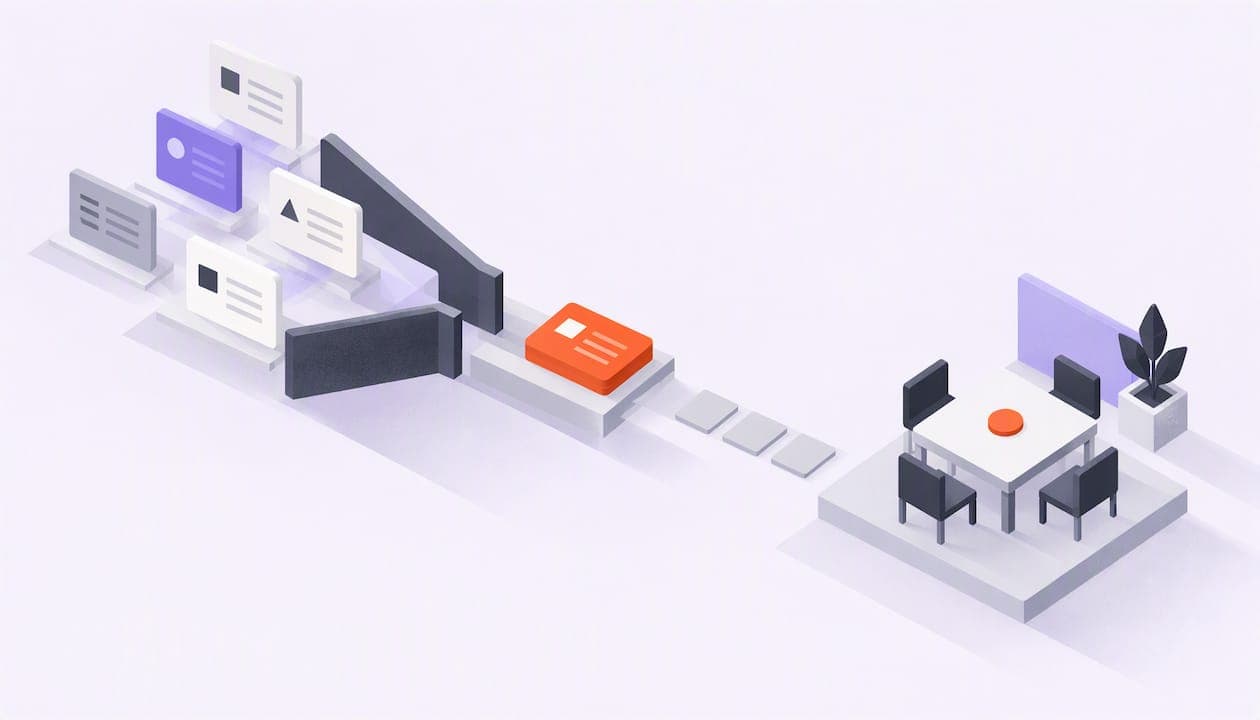
Good customer success call prep comes down to three things: know the account's current state, know what happened since your last touch, and walk in with a few prioritized talking points instead of a long agenda. You can do it in about 15 minutes per call if you pull the right inputs and write them into a brief you can read in two minutes. This guide gives you that routine, the checklist behind it, and a way to add a signal most CSMs never see: how the customer's team actually engaged with the documents you sent.
TL;DR
- Build a one-page brief you can absorb in under two minutes: status, what changed, open items, watch-outs, and three to five talking points.
- Spend 10 to 15 minutes on pre-call research: account basics, usage, support history, and your last conversation.
- Treat health scores and automated alerts as a reason to investigate, not as a verdict.
- Check how the customer engaged with your last deck, proposal or QBR. Page-level views and forwarding show what they care about before they say a word.
- Confirm attendees and agenda 48 hours ahead, and never make the customer repeat what they already told you or sales.
Table of Contents
- What call prep is actually for
- The pre-call research: what to pull and where
- Build the two-minute brief
- Read the health score, then question it
- The signal most prep misses: how they engaged with your documents
- Prep differently for different calls
- A 48-hour prep timeline
- Questions to bring to almost any call
- Common prep mistakes
- Our perspective: prep is where document signals pay off
- Put document engagement into your prep
- FAQ
- Sources
What call prep is actually for
Prep has one job: to keep you from walking in blind and to keep the customer from repeating themselves. A meeting-prep framework for CSMs and customer engineers states the principle plainly: optimize for a brief that can be absorbed in two minutes. That constraint is useful. If your notes take ten minutes to read, you will not read them before the call, and neither will anyone covering for you.
So prep is not a research project. It is a filter. You gather a lot, then keep only what changes what you say or ask in the next 30 minutes.
The pre-call research: what to pull and where
One customer success calls guide suggests spending 10 to 15 minutes on pre-call research, starting with account basics such as company size, industry and contract details. That is a sensible budget. Here is how we would spend it.
| Input | Where it lives | What you are looking for |
|---|---|---|
| Account basics | CRM | Plan, contract dates, seats, key contacts, who signed |
| Product usage | Your product analytics | Trend since last call: up, flat or down, and which features |
| Support history | Help desk | Open tickets, repeated issues, tone of recent threads |
| Last conversation | Call notes, email | Commitments made, questions left unanswered |
| Sales handoff | CRM notes, deal documents | Goals the customer stated before they bought |
| Document engagement | Your document tracking | Which pages of your last deck or proposal got attention, and who else saw it |
The last row is the one most teams skip, and it is where we will spend extra time below.
Build the two-minute brief
The same meeting-prep framework gives a rigid structure, and rigid is the point. Copy it into a template and fill it in every time:
- One-line status. Health, renewal timing, temperature. Example: "Yellow, renews in 74 days, warm but quiet since the admin left."
- What happened since the last touch. Usage changes, tickets, emails, meetings.
- Open items. Commitments you or they made, and questions still unanswered.
- Watch-outs. Likely friction: a billing dispute, a missed deadline, a new stakeholder.
- Three to five talking points, in priority order.
If you can only fit one thing on the page, make it the open items. Nothing erodes trust faster than a customer reminding you of a promise you made.
A worked example
Say you are preparing for a mid-quarter check-in with a 60-seat account.
- Status: Yellow, renews in 90 days, champion still engaged.
- Since last touch: weekly active users fell for three weeks; two tickets about permissions, one still open.
- Open items: you promised a permissions walkthrough; they asked about a reporting export.
- Watch-outs: a new VP joined their team last month and has not been on any call.
- Talking points: (1) close the permissions ticket, (2) ask what changed in how the team works since the VP arrived, (3) confirm success criteria for renewal, (4) schedule the export demo.
That is readable in under two minutes, and every line gives you something to say.
Read the health score, then question it
Health scores are a good starting point for deciding how to spend your prep time. One renewal playbook describes a model weighted roughly 40% engagement, 30% satisfaction and 30% value realization, with scores under 60 in the red zone, 60 to 79 in yellow and 80 to 100 in green. Treat those numbers as an example of a model, not a standard: your weights should reflect what predicts churn in your own book of business.

The bigger point is what you do with the score. A handbook on using automation in customer success argues that alerts, such as a score dropping below a threshold, should trigger investigation, while the CSM decides the engagement strategy based on the relationship. A red account with a happy champion and a seasonal usage dip needs a different call than a red account with a silent champion.
Before every call, ask of the score: what is driving it, and does that match what I know about the people?
The signal most prep misses: how they engaged with your documents
Usage data tells you what happens inside your product. It tells you nothing about what the customer's team thinks of the proposals, renewal decks, QBR summaries and onboarding plans you send them. Yet those documents are where buying and renewal decisions get discussed internally.
Page-level document analytics fill that gap. Instead of a simple "opened" notification, you see which pages got attention and whether the document traveled to someone new. For call prep, that translates into concrete moves:
- Pricing or renewal page read three times. Put commercial terms near the top of the agenda instead of saving them for the end.
- A deck forwarded to a new person. Someone you have never spoken to is now part of the decision. Ask your champion who else is involved and offer to include them.
- Roadmap or integration pages skipped entirely. Your planned talking point may not matter to them. Ask what they need first.
- No engagement a week after you sent the QBR summary. Open the call by checking whether it reached the right people, instead of assuming they read it.
Two cautions. Engagement is a clue, not proof: a long dwell time can mean interest or confusion. And a forwarded document is a reason to ask a question, not to assume anything about who forwarded it or why. Our post on buyer committee tracking goes deeper on reading how many people are touching a deal, and the piece on engagement scoring shows how to turn page behavior into a consistent hot, warm or cold read.
Prep differently for different calls
The brief stays the same shape, but the emphasis shifts.
Kickoff calls
A kickoff is for discovery and alignment, not training. A client onboarding checklist calls turning the kickoff into a training session the most common momentum killer, noting that training in a demo environment rarely transfers to production use. The same guide recommends confirming attendees and agenda 48 hours ahead, because last-minute confirmation often shows that half your prepared material is irrelevant.
Prep for the kickoff by reading everything sales learned. Then plan to ask the customer to restate their goals anyway. A customer success outcomes discussion suggests the framing "I like to hear it from you," which lets you validate what you inherited and probe deeper rather than making the customer feel like a ticket number.
Check-ins
For routine check-ins, the brief is mostly about change: what moved since last time, and what you promised. Keep your talking points to three. If the account is green and stable, say so and use the time to ask about their goals for next quarter.
QBRs and renewals
A QBR should feel like a strategy session, not a sales pitch. The renewal playbook says to prepare ruthlessly before the call. For a QBR, that means the brief plus three extras: the outcomes they said they wanted, the evidence that you delivered them, and one clear next-quarter recommendation. Check how their team engaged with the last QBR deck, since a skipped results page and a heavily read pricing page tell two very different stories.
Escalations
When a customer is upset, the brief is shorter and the order flips. Lead with the facts of the problem, the timeline of what happened, and what you can actually commit to. Do not walk in with talking points about expansion.
A 48-hour prep timeline
- 48 hours out: confirm attendees and agenda in writing. Send a short agenda the customer can edit.
- 24 hours out: pull the inputs from the table above. Note anything that changed.
- 1 hour out: write the two-minute brief. Cut anything that does not change what you will say.
- 5 minutes out: reread the open items and the first question you will ask.
- Right after the call: write down commitments with owners and dates, while you still remember them. That note becomes the next call's open items.
Step five is the one that makes the whole system cheaper over time. Every call's follow-up notes become the next call's prep.
Questions to bring to almost any call
Generic questions waste the customer's time. These are anchored in what you have already learned:
- "Last time we talked about [goal]. What has changed since?"
- "I noticed [team] has been using [feature] less. Is that expected?"
- "Who else on your side should see what we cover today?"
- "What would make this renewal an easy yes for you?"
- "Is there anything you expected from us that you have not seen yet?"
Each one shows you did your homework, which is the real purpose of prep.
Common prep mistakes
- Over-preparing. A 20-slide dossier nobody reads. Keep to the brief.
- Trusting the score blindly. Use it to decide where to dig, not what to conclude.
- Ignoring the people. Job changes and new stakeholders explain more churn than any chart.
- Skipping the debrief. Without notes, next week's prep starts from scratch.
- Prepping only the content. Also decide the one outcome you want from the call, whether that is a decision, an introduction or a date.
Our perspective: prep is where document signals pay off
We build WarmDoc for teams who send decks and proposals and then wonder what happened to them. Most tools tell you a file was opened. That is a weak signal, and it can even be noise from an automated scanner rather than a person. What actually helps you prepare is knowing which pages got attention and whether the document reached someone new.

For customer success, we think this matters more than it does for sales, because the relationship is already live. A CSM does not need to chase. A CSM needs to arrive prepared, with a good first question. Seeing that the renewal page was read twice, or that your QBR summary was forwarded to a finance contact, gives you that question.
We also believe signals should not decide for you. Analytics find patterns; people decide what they mean and what to do. That is the same stance we take in our piece on sales coaching insights. Use the data to ask better questions, then listen to the answers.
— Ty
Put document engagement into your prep
If your prep routine already pulls CRM, usage and support data, document engagement is the missing column. WarmDoc gives you page-level analytics, forwarding detection, recipient-specific tracking and real-time notifications, and you send tracked links from your own inbox. The Free plan costs $0 per month. Pro is $19 per month per user, and Team is $39 per month per user; annual pricing is $190 and $390 per user per year respectively. See the plans and pricing or how it works.
If you want to see how the underlying metrics fit together, our guide to sales content analytics is a good next read.
FAQ
How long should customer success call prep take?
About 10 to 15 minutes for a standard call is a reasonable target, in line with guidance on pre-call research. Strategic calls such as QBRs and renewals deserve more, but the brief you read before dialing should still take under two minutes.
What should be in a customer success call brief?
A one-line status, what happened since the last touch, open items, watch-outs and three to five prioritized talking points, following the brief structure above. Add the account's contract dates and key contacts if they are not obvious.
How do I prep for a kickoff call?
Read the sales handoff, confirm attendees and agenda 48 hours ahead, and plan for discovery and success criteria rather than training. Ask the customer to restate their goals so you can validate them, as practitioners recommend.
Can analytics help with call prep?
Yes, if you treat them as prompts for questions. Usage trends, health scores and document engagement each show where to look, but your knowledge of the people decides what the signal means. Page-level views of your last deck or proposal can reveal what the customer cares about and who else is involved.
Sources
- Meeting prep framework for CSMs and customer engineers
- Customer success calls and troubleshooting guide (2026)
- Customer success renewal playbook: health scores that predict churn
- How we use automation in customer success handbook
- Client onboarding checklist: 15 steps (2026)
- Outcomes-based customer success best practices