
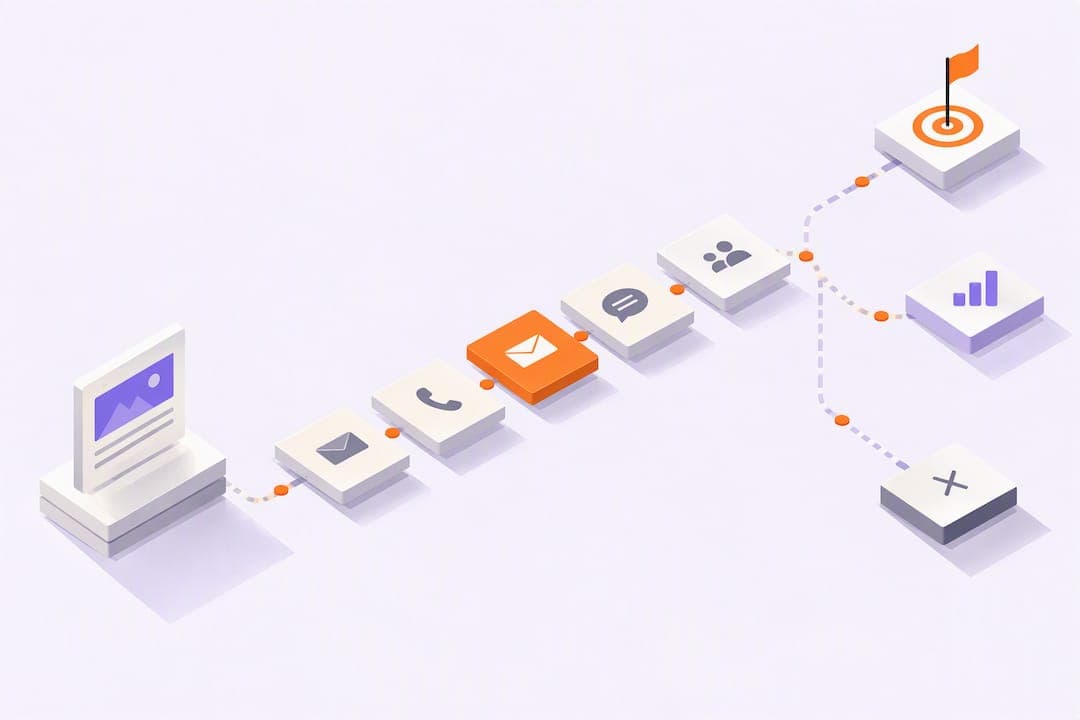
A follow-up cadence is the planned rhythm of touches, timed and sequenced across channels, that you use to reach a prospect until they respond, book a meeting, or opt out. For most cold B2B outreach, start with 8 to 10 touches spread over roughly three weeks; for warm leads, 6 to 8 touches over two weeks works better. Getting this rhythm right raises reply and meeting rates without burning out your list.
TL;DR:
- Cold outbound cadences typically involve 8 to 12 touches over two to four weeks, while warm leads usually require 6 to 8 touches within two weeks.
- The cadence's timing should shorten for prospects who already show interest and lengthen for cold contacts to improve reply rates.
- Specific decision and compliance rules are essential, including immediate reply pausing, route signals, and mandatory opt-out mechanisms in emails.
- Most reply volume comes from the first follow-up, which can increase reply rates by roughly 49 percent when executed promptly.
- Using page-level document engagement signals allows dynamic cadence adjustments and faster routing of high-intent prospects.
Table of Contents
- What is a follow-up cadence, and how is it different from a sequence
- The core elements every repeatable cadence must specify
- Copy-ready cadence templates you can adapt this week
- When to speed up, slow down, or stop a cadence
- A metrics-first framework for testing and improving cadences
- Turning document engagement into cadence decisions
- What managers get wrong about rolling out cadence discipline
- Where document engagement data fits into your cadence
- Sources
- FAQ
What is a follow-up cadence, and how is it different from a sequence
People use "cadence" and "sequence" interchangeably, but they describe different things. A sequence is the specific set of steps: the actual emails, calls, and LinkedIn messages, written and ordered. A cadence is the tempo that governs those steps: how many touches, how far apart, and across which channels. You can run the same sequence content at two different cadences, aggressive for an inbound demo request, stretched for a cold list, and get very different results.
The distinction matters because teams often fix the wrong variable. A rep with low reply rates might rewrite every email in the sequence when the real problem is a cadence that's too slow to catch attention or too fast to seem unscripted.
Cadence needs shift by scenario:
- Cold outbound: no prior relationship, so the cadence needs more touches and more patience before a reply arrives.
- Inbound or post-demo follow-up: the prospect already showed intent, so a shorter, faster cadence capitalizes on that momentum.
- Event follow-up: a conference or webinar gives you a built-in reason to reach out fast while the context is still fresh.
- Re-engagement: dormant leads need a slower, lower-pressure cadence that doesn't feel like a cold restart.
As a rule, shorten the cadence when the prospect has already signaled interest and lengthen it when you're starting cold. Sales-sequence best practices generally put cold cadences at 8 to 12 touchpoints over two to four weeks, with warm cadences compressed into a shorter window.
The core elements every repeatable cadence must specify
A cadence isn't repeatable until it's written down with enough detail that any rep on the team would run it the same way. That means specifying five things.
- Channel roles: email carries documentation and detail, phone drives live conversion, LinkedIn adds relationship context, and video or live demos earn their place for higher-value prospects.
- Step intent: each touch should have one job, such as an intro, a value-add, a soft interest check, a direct meeting ask, or a breakup message.
- Timing conventions: front-load the first week with tighter spacing, then stretch intervals as the cadence continues.
- Decision rules: pause immediately on any reply, route hot signals to a closer, and disqualify after an explicit opt-out or after a set number of attempts.
- Compliance rules: every commercial email needs a working opt-out mechanism.
Pro Tip: Write your decision rules before you write your email copy. A cadence without exit conditions just becomes spam with better formatting.
Nearly half of reply volume comes from the first follow-up alone. HubSpot's sales statistics report that the first follow-up email can lift reply rates by roughly 49%, which means a one-and-done outreach habit is leaving most of the pipeline on the table.
On the compliance side, the FTC's CAN-SPAM guidance requires every commercial email to include a clear, conspicuous opt-out, and businesses must honor that request within 10 business days while keeping the opt-out mechanism functional for at least 30 days after the message goes out. Build that into your sequence tooling once, not into every rep's personal workflow.

Copy-ready cadence templates you can adapt this week
These three templates cover the scenarios most teams run into. Treat the timing as a starting point and adjust based on what your own reply data shows.
- Cold outbound (10 touches, about 3 weeks): email on day 1, call on day 3, email on day 5, LinkedIn connect on day 7, email on day 9, call on day 12, email on day 14, LinkedIn message on day 16, email on day 18, breakup email on day 21.
- Warm inbound or post-demo (6 to 8 touches, about 2 weeks): email within an hour of the trigger event, call on day 1, personalized email on day 3 referencing something specific from the demo or form fill, call on day 5, email on day 8, final check-in on day 12.
- Event follow-up (7 touches, 14 days): email within 24 hours referencing the specific session or conversation, call on day 2, email on day 4 with a relevant resource, LinkedIn connect on day 6, email on day 9, call on day 11, breakup email on day 14.
Two scripts cover most of the heavy lifting in any cadence.
- "Next steps" email: two to three short sentences confirming what was discussed, one clear next action, and a specific day and time suggestion. Keep it under 50 words so it reads on a phone without scrolling.
- "Breakup" email: a brief, low-pressure note stating you'll stop reaching out unless they want to continue the conversation, with the door left open. Research on sales email length points to short templates, in the range of 36 words, outperforming longer, more hedged versions.
To scale either script across a team without losing personalization, write them in modules: a fixed opening, a variable line referencing something specific to the prospect, and a fixed call to action. Reps fill in the middle; the structure stays constant.
When to speed up, slow down, or stop a cadence
Timing decisions shouldn't be left to gut feel. A few triggers should move every rep the same way, every time.
Respond within the first hour whenever possible. HubSpot's research on call timing found that responding to a new lead within that first hour sharply increases the odds of booking a meeting, and many companies miss that window entirely. Treat the first hour as the highest-leverage moment in the whole cadence.
Accelerate the cadence when you see:
- Repeat visits to your site or pricing page within a short window.
- A prospect reopening or re-engaging with a shared document multiple times.
- A document being forwarded internally, which often signals a second stakeholder is now involved.
- Unusually long time spent on a specific page, such as pricing or a case study.
Back off or slow down when you see a flatly negative reply, when a whole industry's inbox patterns suggest a slow season, or when a touch would land on a weekend or around a holiday.
Stop the cadence entirely on any of four conditions: a reply of any kind, a booked meeting, an explicit opt-out, or after hitting your attempt ceiling, commonly 8 to 10 attempts for cold cadences. Sales-sequence guidance recommends building these pause triggers directly into your sequencing tool rather than relying on reps to remember them.
A metrics-first framework for testing and improving cadences
Not every metric deserves equal attention, and chasing the wrong one first wastes testing cycles. Sales performance guidance recommends fixing conversion rates first, messaging relevance second, and only then adjusting volume, because adding more touches to a cadence that already converts poorly just produces more poor conversions.
Track these in order of priority:
- Reply rate: the clearest signal that your messaging and timing are landing.
- Meeting-booking rate: whether replies are converting into actual next steps.
- Connect rate on calls: whether your calling windows match when prospects actually pick up.
- Opportunity conversion rate: whether booked meetings turn into real pipeline.
- Open and click rates: useful as early diagnostics, but secondary to the metrics above.
When you run A/B tests, change one variable at a time, subject line, send timing, or channel mix, and let each test run long enough to collect a meaningful sample before calling a winner. A test that ends after a handful of sends tells you nothing.
Pro Tip: Route high-intent engagement signals straight to a senior rep or account executive instead of leaving them in the standard queue. Speed matters more than seniority order once a prospect shows real interest.
Turning document engagement into cadence decisions
Reply rate and open rate tell you whether an email landed. They don't tell you what happened after a prospect opened your deck. Page-level tracking fills that gap: it shows which specific pages held attention, whether the document got forwarded to another stakeholder, and whether the same person came back to review it again.
That data turns into three concrete cadence actions: accelerate the next touch when a prospect reopens the deck days after the first view, personalize the next message around the specific page they lingered on, and route the lead to an account executive the moment a forward suggests a second decision-maker entered the picture.

The workflow is simple: send a tracked deck, watch for page-level signals, and let those signals trigger a change in the active cadence rather than waiting for the next scheduled touch, as demonstrated by Equinox Strategies' AI Automation & Lead Systems. WarmDoc's feature set is built around exactly this kind of signal, and its pricing page outlines plan options for teams that want to test the approach.
What managers get wrong about rolling out cadence discipline
Most cadence rollouts fail from trying to cover the whole pipeline at once. Pilot with one segment, agree on baseline KPIs before you start, and review results weekly so you can adjust fast rather than waiting a full quarter.
Coaching works best as short, concrete checks: review each rep's active sequences weekly, use a simple scorecard against the playbook, and flag the same objection showing up across multiple reps as a signal the script needs a fix, not the rep.
— Ty
Where document engagement data fits into your cadence
WarmDoc gives sales, marketing, and customer success teams page-level analytics on every deck they send: which pages got attention, whether the document was forwarded, and who opened it again after the first view. That turns a vague "they opened it" notification into an actual signal you can act on inside your cadence.

- Sales teams use it to know which prospects to call first instead of guessing from open notifications alone.
- Marketing teams use the same page-level data to see which content sections actually hold attention.
- Customer success teams use forwarding signals to spot when a renewal conversation has quietly picked up a second stakeholder.
If your cadence decisions are currently based on opens alone, the Free, Pro, and Team plans are a reasonable place to start testing whether page-level signals change how you prioritize follow-ups.
Sources
- CAN-SPAM Act: A Compliance Guide for Business | Federal Trade Commission
- Sales sequences: 12 best practices for B2B teams in 2026 | HubSpot Blog
FAQ
What does follow-up cadence mean?
A follow-up cadence is the planned tempo of outreach touches, how many, how spaced, and across which channels, used to reach a prospect until they reply, book a meeting, or opt out. It governs timing and rhythm, while the sequence covers the actual message content for each step.
How do you professionally say follow up?
Common professional phrasings include "checking in," "circling back," or "following up on our last conversation." Any of these works as long as the message states a clear reason for reaching out and a specific next step.
Can you give me an example of a meeting cadence?
A typical warm follow-up cadence runs 6 to 8 touches over about two weeks: an email within the first hour of a trigger event, a call the next day, a personalized email a few days later, another call, and a final check-in around day 12. Cold cadences usually stretch longer, often 8 to 10 touches over roughly three weeks, as recommended in sales-sequence best practices.
What does posting cadence mean?
Posting cadence refers to how often content gets published on a channel, such as a blog or social account, rather than outreach touches to an individual prospect. It follows the same underlying idea as a follow-up cadence: a consistent, planned rhythm rather than sporadic activity.