
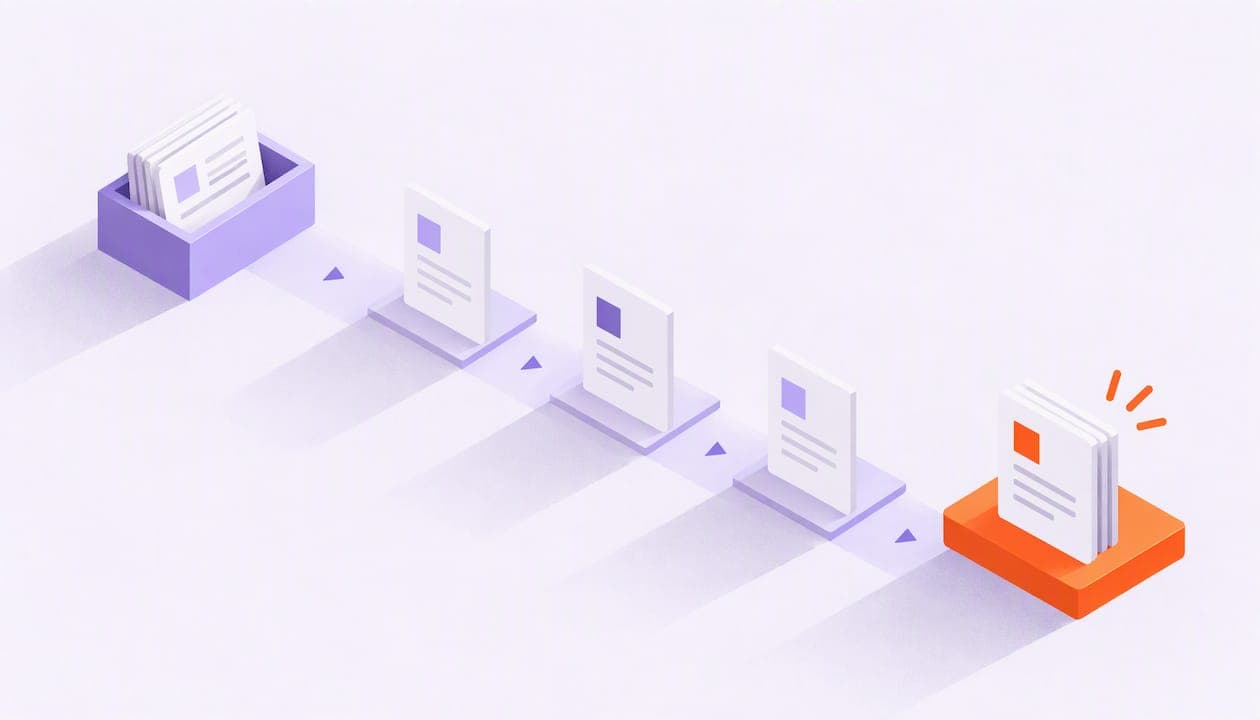
Proposal turnaround time is the time between a prospect asking for a proposal (or your team deciding to bid) and the moment the finished document lands in their inbox. Typical figures run from a few hours for a simple quote to several weeks for a formal RFP. This guide shows you how to measure it, what the numbers look like, how to shorten it without sloppy work, and what to track once the proposal is out.
TL;DR
- Turnaround time covers every step from request to delivery: gathering info, writing, pricing, reviews and final production. It is not just writing time.
- Benchmarks vary by deal type. Loopio's report puts the average at 25 hours of effort per RFP, while platform-based proposals can be assembled in minutes.
- Speed helps, but only paired with quality. Track win rate and sales-cycle length next to turnaround, not instead of them.
- The clock does not stop at "sent." What the buyer does with the proposal tells you where to spend your next hour.
Table of Contents
- What proposal turnaround time actually measures
- What is a typical turnaround time?
- Why speed matters, and where it stops mattering
- What slows a proposal down
- How to cut turnaround time without lowering quality
- The metrics to watch next to turnaround time
- The part most teams skip: what happens after you send
- Perspective: speed gets you in the room, signals keep you there
- Track what happens after you send with WarmDoc
- A simple 30-day plan
- FAQ
- Sources
What proposal turnaround time actually measures
A clean definition: proposal turnaround time is the total duration from the request or bid decision to final delivery, and it includes information gathering, content creation, pricing, reviews and final production.
For RFPs, Loopio's metrics guide frames it as the time from receiving the RFP to submitting the response. That is the whole cycle, not the hours someone spent typing.
It helps to split it in two:
- First-draft turnaround: from request to the first complete draft.
- Total cycle time: from request through drafting, review, approval, formatting and submission. Tribble draws this same distinction.
Most teams only feel the second one. A draft that takes two days can still sit for a week waiting on legal, pricing approval or a subject-matter expert.
Turnaround time versus the buyer's clock
Your number is only one slice of the deal timeline. Cobl's 2026 analysis says that in a typical mid-market B2B RFP, about 60% of the total timeline is consumed by the buyer before the vendor even receives the document. You can't shrink that part. You can control what happens after the request arrives.
What is a typical turnaround time?
There is no single number. It depends on the deal, the buyer and how much of the proposal is reusable. Here is what the available data says.
| Proposal type | Reported figure | Source |
|---|---|---|
| Effort per RFP | 25 hours, down from 30 hours in the prior report | Loopio 2025 trends report |
| Average RFP completion (2020 study) | 10.5 days; most common answer 3 to 5 days (17% of respondents) | Loopio 2020 benchmarks |
| Simple commercial vendor questionnaires | 5 to 10 business days expected | SEQUESTO |
| Formal government tenders | 3 to 6 weeks often allowed | SEQUESTO |
| Large or complex RFPs | 10 to 15 business days is realistic; fast-moving opportunities may need 24 to 72 hours | ECB Solutions |
| Platform-built sales proposals | Average creation interval of 17 minutes; 51 hours from first client open to close | Proposify 2024 data, as reported by Stealth Agents |
Two things stand out. Hours of effort and calendar days are different measures, so don't compare them directly. And a formal RFP and a two-page quote for an existing customer are different animals. Benchmark yourself against your own deal types.
How long should the whole RFP process take?
If you are asking from the buyer's side, Tender X suggests 10 to 12 weeks from issue to award for a mid-size services purchase, 6 to 7 weeks for simple scopes, and 16 weeks or more for complex or regulated ones. Public-sector procurement typically runs 3 to 6 months. For vendors, Responsive's guidance says many proposal managers consider about 30 days ideal for the proposal timeline, depending on the team and the RFP.

Why speed matters, and where it stops mattering
Fast responses read as a sign of how you will behave as a vendor. SparrowGenie notes that buyers increasingly use turnaround as a proxy for future service responsiveness. One agency survey, as cited by US Tech Automations, found agencies replying to RFPs within 24 hours won at a rate 2.3 times higher than those taking three days or more. Treat that as directional: it comes from agencies, and fast responders may simply be better organized or better qualified in the first place.
Missing the buyer's window is the more concrete risk. An EOI Digital analysis described teams whose median submission time of 14.3 days exceeded the buyer's 12-day window.
And speed has a floor. Iris AI warns that teams under heavy time pressure often recycle stale content, which hurts the bid. Loopio's guidance treats turnaround as a planning and resourcing metric, not a score of success by itself. It only becomes meaningful when you connect it to advancement or wins.
What slows a proposal down
The APMP describes the RFP response workflow as a chain: review requirements and deadlines, plan milestones and responsibilities, develop and review content, run final quality and compliance checks, submit, and confirm receipt. Delays tend to hide in the handoffs between those links.
In practice, look for these:
- Waiting on the buyer for missing details, such as scope, headcount or timeline.
- Hunting for the right past answer, case study or price sheet.
- Pricing approvals that sit in someone's inbox.
- Serial reviews, where legal waits for finance, which waits for the sales director.
- Formatting by hand, then reformatting after edits.
- Late kickoff. Nobody starts planning until the deadline is close.
Zephior recommends separating active handling time from internal queue time, buyer-information waiting time, specialist-review time and rework. Total duration alone is a weak diagnostic, because a 10-day proposal could be 2 days of work and 8 days of waiting.
How to cut turnaround time without lowering quality
Here is a practical sequence you can start this week.
- Measure first. Flowcase suggests recording three data points: request or release date, submission date and total labor hours. A shared spreadsheet is enough.
- Build one searchable library. Put approved case studies, security answers, bios and pricing language in one place. The same Flowcase guidance points to centralized content libraries, templates that automate formatting, and defined reviewer roles with parallel reviews.
- Template the common cases. Keep a short template for small deals and a fuller one for larger ones. Decide in advance which sections must be customized and which can be reused as is.
- Assign roles at kickoff. One owner, named reviewers, and a date for each. Ask reviewers to work at the same time, not in a line.
- Set a go/no-go rule. Not every request deserves a full response. A short qualification check saves hours for the bids you can win.
- Route requests automatically where volume is high. One reported case of a 150-person agency cut first response time from 18 hours to 20 minutes through automated routing. That is a vendor-reported result, so use it as a sign of what is possible, not a promise.
- Protect the review step. Compress drafting and queues, not the checks that catch errors.
Teams that adopt dedicated software often report gains. A 2022 QorusDocs benchmark study found that 76% of software users reduced the time spent completing responses (53% median improvement) and 70% processed a higher volume of requests.
Keep deadlines on the calendar, not in heads
Timelines slip when approvals and submission dates are fuzzy. If you manage a proposal team, a clear review cadence matters as much as the template. This coaching framework for sales managers is a good companion for setting expectations, giving feedback and keeping a team on a schedule.
The metrics to watch next to turnaround time
Turnaround time on its own can be gamed. Send sloppy proposals fast and the number looks great. SparrowGenie suggests pairing it with win rates, sales-cycle length, forecast accuracy and stage-specific durations.
A starter dashboard:
- Turnaround: request date to send date, in business days.
- Active hours: time people actually worked on it.
- Win, shortlist, loss and no-decision rates. Zephior also lists requirement coverage, material defects, review findings, rework and submission acceptance as companions.
- Time from send to first buyer response.
- Time from send to decision.
Loopio notes that tracking turnaround helps you forecast whether you can meet a deadline, estimate resources, set advance-notice expectations and spot inconsistent processes. That is the real payoff: fewer surprises.
The part most teams skip: what happens after you send
Most turnaround reports end at "submitted." But for a sales team, the next question decides the deal: did anyone read it, and who?
A proposal that went out in four hours and sits unread is worse than one that took two days and gets forwarded to the CFO. Without post-send data, you are guessing when to follow up.
The signals worth tracking:
- Opens by recipient, so you know who actually looked.
- Time on each page. Heavy attention on pricing or implementation tells you what the buyer is weighing.
- Forwarding. A new viewer you did not send to often means a decision maker or influencer is now involved.
- Return visits. A second or third look days later is usually a stronger signal than a first open.
- Which version each person saw. Our guide on proposal version tracking shows how to avoid a buyer reading an outdated number.
Once you have those signals, timing is the next question. Our guide to sales follow-up timing covers how long to wait at each stage, and these proposal follow-up email templates give you wording for each touch. For a broader view, see our proposal analytics tactics.
A short example
Say you send a pricing proposal at 10 a.m. on Tuesday, two hours after the prospect asks. By noon the champion has opened it and spent most of her time on page 6, the pricing page. On Wednesday morning, a new name appears: her finance lead, who reads pages 6 and 7 twice.

You now know three things. The champion is engaged, price is the topic, and finance is involved. Your follow-up is no longer "just checking in." It is an offer to walk finance through the payment options. That is a better call than any generic nudge, and it only works because you saw it warm up.
Perspective: speed gets you in the room, signals keep you there
We build WarmDoc for sales, marketing and customer success teams, and we see the same pattern. Teams put real effort into shrinking the time it takes to produce a proposal, then go quiet the second it is sent. They know when it left. They don't know what happened next.
We think turnaround time is half a metric. The other half is response time to the buyer's behavior. A simple open notification isn't enough, because opens can be noisy, and a preview scanner can trigger one without a human reading anything. Page-level attention and forwarding are far harder to fake and far more useful.
So our advice is to measure both sides. How quickly can you get a good proposal out? And how quickly do you act when the buyer shows real interest? The teams that do both stop chasing every open and start calling the right person on the right day, with something specific to say.
— Ty
Track what happens after you send with WarmDoc
WarmDoc gives you page-by-page engagement tracking, forwarding detection, recipient-specific tracking and real-time notifications. You send tracked links from your own inbox, and deals get scored hot, warm or cold so you know whom to call first. Our features page walks through each one.

There is a free plan at $0 per month, so you can test it on your next proposal. Pro is $19 per month per user and Team is $39 per month per user. On annual billing, Pro is $190 per year per user and Team is $390 per year per user. Start free or see pricing.
If you want to automate what happens when a buyer shows interest, our guides on real-time engagement alerts and follow-up workflows built on page signals are a good next read.
A simple 30-day plan
You don't need a new process overnight. Try this:
- Week 1: Log request date, send date and hours for every proposal. Nothing else.
- Week 2: Find your biggest wait. Is it pricing approval, content hunting or review? Fix only that.
- Week 3: Build or clean up one template and one shared content folder.
- Week 4: Start tracking what buyers do after sending, and set a rule for follow-up when a new person opens the document or a pricing page is read twice.
At the end of the month, compare turnaround, response rate and win rate against your starting point. If turnaround dropped but win rate fell too, slow down and look at quality. If both improved, keep going.
FAQ
What is a good proposal turnaround time?
It depends on the deal. Simple commercial questionnaires usually expect 5 to 10 business days, while large or complex RFPs can reasonably take 10 to 15 business days. A simple sales quote should often go out the same day or the next. Set targets by deal type and compare against your own history.
How many hours does an RFP take?
Loopio's 2025 report found teams spent an average of 25 hours per RFP, down from 30 hours in the prior report. That is effort across the team, not elapsed calendar time. Your number will be higher if content is hard to find or reviews run one after another.
Does a faster proposal win more deals?
Often it helps, but the evidence is mixed in quality. One agency survey found much higher win rates for 24-hour responders, but speed alone doesn't explain it. Rushed proposals with stale content can hurt the bid, so track win rate alongside turnaround.
How do I know if the buyer actually read my proposal?
Use a tracking link that shows opens by recipient, time per page and forwarding, not just a delivery notice. That tells you whether a real person read the pricing page and whether new stakeholders joined. It also tells you when to follow up, and with what.
Sources
- Proposal Turnaround Time, SparrowGenie Sales Glossary
- RFP Metrics That Matter, Loopio
- How RFP Response Time: How AI Agents Cut Turnaround, Tribble
- The RFP process, step by step, Cobl
- RFP Response Trends & Benchmarks Report, Loopio
- Response Management Benchmarks & 2020 Trends, Loopio
- How to cut RFP turnaround time, SEQUESTO
- Proposal Timelines, ECB Solutions
- Sales Proposal Turnaround Time Statistics 2026, Stealth Agents
- RFP Timeline: How Long Should an RFP Take, Tender X
- Optimize Your Process Using Proposal Timelines, Responsive
- RFP Routing by Service Line, US Tech Automations
- Your RFP Response Took Nineteen Days, EOI Digital
- RFP Response Time: 2026 Benchmarks, Iris AI
- Winning Business Ecosystem, APMP
- How to measure proposal team performance beyond win rate, Zephior
- 10 Ways to Dramatically Improve Proposal Turnaround Time, Flowcase
- Not Your Average Benchmark Study, QorusDocs
- A Coaching Framework for Sales Managers: 4 Steps