
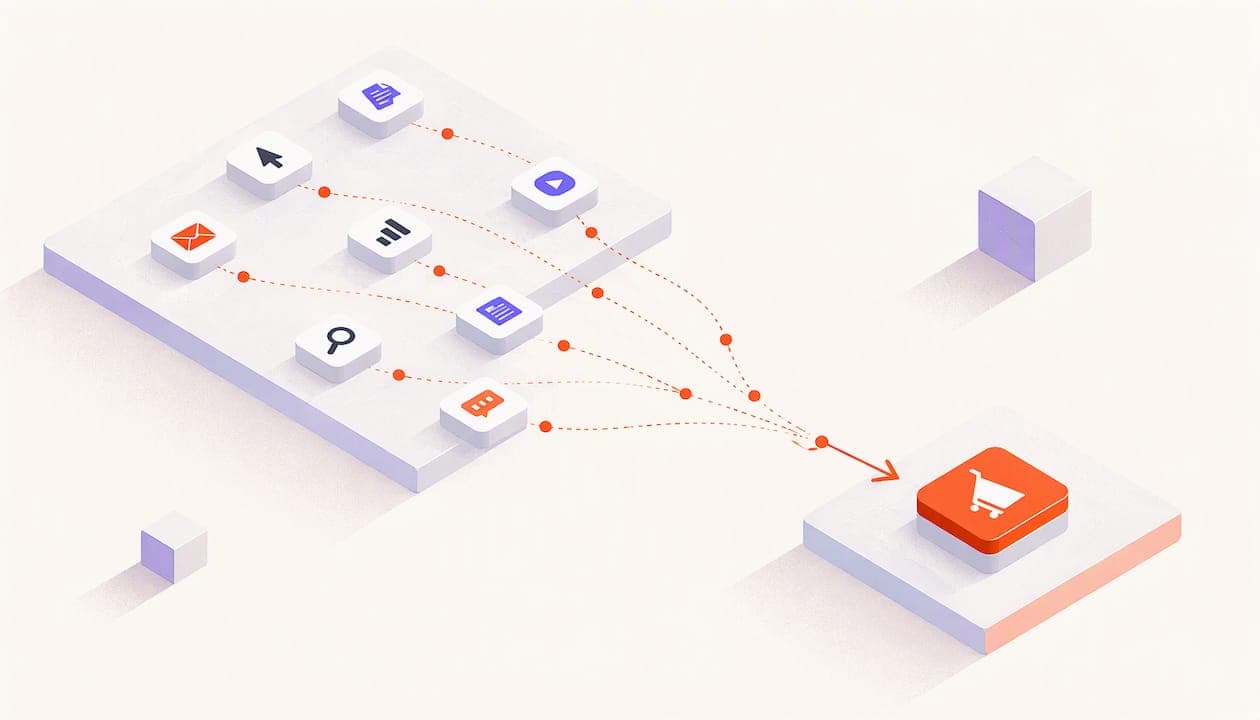
You detect buying intent by watching what a prospect does, then weighting each action by how close it sits to a decision. A pricing-page visit, a proposal read twice, a deck forwarded to a new stakeholder: those are signals. A single blog view or one email open is not. Combine the signals you can confirm, score them, and act while they are fresh.
This guide shows you which signals to trust, how to score them, how to avoid false alarms, and how to turn your own sales documents into one of the strongest sources of intent you have.
TL;DR
- Buying intent is observable behavior that shows a prospect moving toward a purchase. Treat it as rising interest, not a promise to buy.
- Strong signals are repeat pricing-page visits, comparison and case-study views, demo requests, and several people from one account engaging.
- Weak signals, like one blog visit or a lone email open, need context before you act on them.
- Score signals by strength, stakeholder weight, recency and fit, and follow up fast on the top tier.
- Your own documents (proposals, decks, one-pagers) give page-level intent data that website analytics can't.
Table of Contents
- What buying intent actually means
- The signals worth trusting
- Why documents are the missing signal
- Step by step: how to detect buying intent
- Build a simple scoring model
- Telling real signals from false ones
- What to do when a signal fires
- A worked example
- Perspective: what we've learned about intent
- Measure whether it works
- Privacy and limits
- Start tracking document intent with WarmDoc
- FAQ
- Sources
What buying intent actually means
Buying intent is how ready a lead is to buy in the near term. Intent data is the raw behavior you use to estimate it: page visits, downloads, searches, replies. One vendor guide draws the line clearly: purchase intent is the predicted likelihood of a future purchase, while intent data is the input behind that prediction.
That difference matters. A prediction is a guess dressed up in a score. An action you saw with your own eyes, like a prospect opening your proposal three times in a day, is a fact. The best detection programs lean on facts first and use predictions to fill gaps.
There are two broad sources:
- First-party signals. Activity on channels you own: your website, emails, webinars, chat, product trials, and the documents you send.
- Third-party signals. Research activity across the wider web, usually reported at the company level. For example, Apollo's documentation explains that its intent works at the account level: it can show a company is researching a topic, but not which employee did the research.
That last point is the catch with third-party data. You learn that a company is interested, but not who. First-party signals are the opposite: you usually know exactly who clicked, which page they read, and when.
The signals worth trusting
Not every action says the same thing. Think of signals in three tiers.
Strong signals: act the same day
- Demo or pricing requests
- Repeat visits to your pricing page
- Views of comparison pages and case studies
- Several people from the same account engaging
- Trial sign-ups and heavy product usage
- A proposal or quote reopened, or forwarded to someone new
A B2B signals guide lists repeat pricing visits, case-study and comparison engagement, demo requests and multi-stakeholder activity as high-intent, and a single blog visit as low-intent. That matches what most sellers see in practice.
Medium signals: nurture and watch
- Webinar attendance
- Multiple visits to product or feature pages
- Replies to emails that ask a question
- Repeated opens of a case study you sent
Weak signals: log them, don't chase them
- One blog post view
- A single email open
- A newsletter signup
- A gated download on its own
On that last one, UserGems cautions that a gated-content download usually points to early-stage curiosity, not proof an account is in-market. Repeated pricing visits, product evaluation, trials and demo requests are stronger evaluation-stage signs.
Why documents are the missing signal
Most intent guides stop at your website and ad clicks. But in B2B, the deal often lives inside a file: a deck, a proposal, a pricing sheet, a security overview. After your first call, the prospect goes quiet and reads that file with their team. Website analytics can't see any of it.
That is the gap we built WarmDoc to close. When you send a tracked link, you see:
- Which pages each recipient read, and how long they stayed on each
- Whether they came back to the pricing page or the scope page
- Whether the deck was forwarded to someone you haven't met
- Which deals look hot, warm or cold, based on that behavior
A forward is the clearest example. A prospect who shares your proposal with a finance lead or an executive is bringing in the buying committee. That is a stronger signal than any open. We cover how to read it in our guide to document engagement as Tier 1 buyer intent signals and in buyer committee tracking.
Opens are noisy; pages are not
A plain open notification can mislead. Email security scanners and link previews can fetch a document before a human ever sees it, which makes an "opened" alert look like interest when it isn't. Page-level behavior is harder to fake: a human reading page 6 for two minutes looks very different from a scanner hitting the first page for a second. Our breakdown of lead intent versus activity goes deeper on telling the two apart.
Step by step: how to detect buying intent
Here is a workable process for a small or mid-sized sales team. You can run it in a week.
- List your signals. Write down every first-party action you can already capture: pricing-page visits, demo requests, email replies, trial activity, document views.
- Rank them by strength. Put demo requests, pricing visits and forwarded proposals at the top. Put single blog visits at the bottom.
- Add stakeholder weight. A signal from an executive or budget owner counts for more than one from an intern. One scoring matrix in the research applies a 3x multiplier for an executive, as an example of the idea.
- Add fit. An account that matches your ideal customer profile deserves more attention than one that doesn't, however busy it looks.
- Add recency. Yesterday's pricing visit outranks last month's.
- Set thresholds. Decide what score triggers a call, what triggers a nurture email, and what just gets logged.
- Route it. Send high-priority signals straight to the owning rep, with the context attached.
- Review outcomes. Check which signals actually led to replies and meetings, and adjust the weights.
Build a simple scoring model
A useful model combines three things: fit, intent and timing. A Leadfeeder guide describes that combination and notes that deduplication, thresholds and ICP fit help stop signal spam. If you want a clean way to define fit first, this ideal customer profile framework walks through turning data into rep actions.
Here is an illustrative starting point. The numbers are examples, not benchmarks. Tune them against your own win data.
| Signal | Example points | Why |
|---|---|---|
| Demo or pricing request | 40 | Direct ask |
| Proposal forwarded to a new person | 30 | Buying committee forming |
| Pricing page read in a document, 2+ times | 25 | Evaluating cost |
| Repeat pricing-page visit on site | 20 | Evaluation stage |
| Case study or comparison view | 15 | Narrowing options |
| Webinar attended | 10 | Interest, early |
| Single blog or email open | 2 | Almost noise |
Then apply modifiers: multiply by a stakeholder factor for senior titles, add points for ICP fit, and let the score decay as days pass without activity. A score of, say, 60 or more might mean call today; 30 to 59 means nurture with something relevant; below 30 means wait.
If you track documents with us, you don't have to build the document half by hand. Our pipeline scoring sorts deals into hot, warm and cold from page-level behavior.

Telling real signals from false ones
The hardest part of intent work is not collecting signals. It's ignoring the wrong ones. Four habits help.
Look for patterns, not events
One action rarely means much. Clearbit's guidance recommends reading behavior together with context, account fit and timing, since an isolated action may not reflect purchase intent. A pricing visit from a competitor's employee or a student is still a pricing visit. The pattern around it tells you the truth.
Check recency, frequency and breadth
ZoomInfo's guide explains that providers compare recent activity with an account's normal baseline and flag a surge, judging quality by recency, frequency, velocity, breadth, topic relevance and fit. You can borrow the same logic on a small scale. Ask: is this more activity than usual? Is it getting faster? Is it coming from more than one person?
Remember the limit of any signal
The same guide is clear that an intent signal shows rising interest, not a confirmed decision to buy. Validate the account, the topic, the timing and the stakeholders before you act.
Filter out scanners and bots
Automated link checks, spam filters and previews create phantom activity. Look for dwell time and page-by-page movement, which a scanner can't imitate.
What to do when a signal fires
Speed matters. One guide says leads contacted within five minutes are nine times more likely to convert, and recommends responding to high-intent signals within minutes and softer ones within 24 hours. Treat the figure as directional: it is a vendor claim, not a law of physics. But the logic holds. Interest cools.
For each tier, a simple playbook:
- Hot (demo request, forwarded proposal, repeat pricing reads). Call or send a short, specific message within the hour. Reference what they read, such as "Looks like the rollout timeline is a priority. Want me to walk through it?"
- Warm (case study views, a reopened deck). Send one relevant resource and a light question. Don't pounce.
- Cold (a lone open). No action. Keep them in your normal cadence.
One caution: follow up with value, not surveillance. Opening with "I saw you viewed page 4 six times" feels creepy. Opening with a useful answer to what that page probably raised feels helpful. Clearbit's view is that intent works best as a prioritization aid, not a license for intrusive follow-up on weak signals.
Alerts only help if reps act on them. See how to set up real-time engagement alerts so they land in the right place at the right time.
A worked example
Say you sell analytics software and send a proposal to a director on Tuesday morning. Here is what the tracking shows.
Tuesday, 10:15: she opens the proposal and spends 40 seconds on the first two pages. That's polite interest. Nothing to do yet.
Tuesday, 3:40: she reopens it and spends three minutes on the pricing and implementation pages. The link is then opened by two new viewers, so it has been forwarded. One of them reads the security page for four minutes.
That's three signals in a day: repeat reading of the money pages, a forward, and a new stakeholder checking security. You don't need a prediction model to see what's happening. A committee is forming and someone is checking risk.
Your move: send a short note offering a security overview and a call with your solutions engineer, and have the security questionnaire ready. You've answered the objection before it was raised.
Compare that with the website-only view, where you'd have seen none of this.

Perspective: what we've learned about intent
We think most teams chase the wrong data. They buy broad, account-level research feeds and still can't tell which deal to call first on a Thursday afternoon. Meanwhile the strongest evidence sits inside the files they send every day.
We built WarmDoc around three beliefs. First, a page beats an open: knowing which pages got attention shows what the buyer cares about. Second, a forward beats a read: when a document travels to a decision maker, the deal has changed. Third, the tool should help you, not replace you. You send the link from your own inbox, which keeps your deliverability and your relationship intact, and the signals tell you whom to call and what to say.
We also think restraint is part of the job. A score is a reason to look, not a reason to pounce.
— Ty
Measure whether it works
Detecting intent only matters if it changes outcomes. Track operational and revenue results rather than signal volume. Lev8 suggests signal-to-reply, signal-to-meeting, sales-acceptance, false-positive and signal-to-pipeline rates.
Some reported benchmarks give a sense of the prize, though they come from vendor and agency content and your results will differ. One benchmark report cites intent-to-meeting conversion of 11%, dropping below 4% when outreach lags beyond 30 days. The lesson is about speed more than the exact figures.
A lightweight review each month:
- Pull every deal that reached a meeting.
- Note which signals fired in the 14 days before.
- Pull deals that fired signals but went nowhere.
- Raise the weight of signals common in the first group; lower those common in the second.
For teams working on proposals specifically, our proposal analytics tactics show how to turn this review into a routine.
Privacy and limits
Intent data comes with responsibilities. In the US there is no single federal privacy law covering all of this, but state laws such as California's CCPA and CPRA matter. Legal scholars at Utrecht University note these laws are narrower than the GDPR yet still require clear disclosure and consent practices for commercially collected data. For California, the "notice at collection" rule means telling people what categories of personal information you collect and why, before you collect it.
Practical steps:
- Tell recipients that links are tracked, in your privacy policy and where appropriate in your emails.
- Prefer first-party data, where you have a direct relationship.
- Keep only what you need, and suppress contacts who opt out.
- Talk to your own counsel about your state exposure and your contracts. This article is not legal advice.
Our guide to safe document link tracking covers the workflow side.
Start tracking document intent with WarmDoc
If you want page-level signals without a heavy setup, you can try WarmDoc on the Free plan at $0 per month and start free. Paid plans add more: Pro is $19 per month per user, and Team is $39 per month per user. Annual billing is $190 per year per user for Pro and $390 per year per user for Team, listed on the pricing page. See the full list on our features page, or read how WarmDoc works first.
You get page-by-page engagement, forwarding detection, real-time notifications, hot, warm and cold pipeline scoring, and a Zapier integration to push signals into the tools your team already uses.
FAQ
What does buying intent mean?
Buying intent is a lead's readiness to purchase in the near term, judged from behavior such as page visits, downloads, demo requests and engagement with your content. It's an estimate of timing and interest, not a guarantee of a deal.
What are the best buyer intent signals?
The strongest are demo requests, repeat pricing-page visits, case-study and comparison views, and several stakeholders from one account engaging. For sellers, a proposal that is reread or forwarded to a new person is among the clearest signals available.
What's the difference between first-party and third-party intent data?
First-party data comes from channels you own, so you usually know the person and the page. Third-party data comes from research activity elsewhere and is often reported at the company level only. Many teams start with first-party signals because they're more specific and easier to verify.
How fast should I follow up on an intent signal?
For strong signals like a demo request, aim for minutes, or at least the same day. For softer signals, within about a day is a reasonable target. Always lead with something useful rather than a mention of what you tracked.
Sources
- UpLead: Purchase Intent: Types, Signals and Strategies
- Apollo: Buying Intent Overview
- Salesmotion: B2B Buying Signals
- UserGems: Buying Signal Examples
- Leadfeeder: B2B Buying Signals
- Clearbit: How to use intent signals
- ZoomInfo: What Is Intent Data?
- Lev8: First-Party Intent Signals
- The Starr Conspiracy: B2B ICP and Buyer Persona Benchmarks
- Utrecht University: Regulating the Data Market
- TermsFeed: CCPA notice at collection